
Energy advice: Get the best out of your heating in the cold weather
Do you know someone who would enjoy this article?
Our energy advice service team provides support to people in Greater Manchester and Lancashire, whatever the season.
Here, the team has some helpful advice on how to get the best out of your boiler and heating system controls as the weather gets colder…
Now that the winter weather is approaching, it’s time to make sure that we know how to get the best use out of our boiler and heating systems main controls – the timer or controller, and the main thermostat. To get the best from them, take a little time to understand what they do.
Thermostats
A thermostat is a simple on/off switch that responds to the temperature of the room that it is in.
For a home heating system, when the room is below the temperature that it is set to, the thermostat will send a send a signal to your boiler to switch on. Once it reaches the set temperature in the room, it then tells your boiler to stop because the room is warm enough. (If you have air conditioning, this is reversed where the thermostat is telling your system to cool the room when it is above the set temperature).
Typically, the main thermostat for a heating system is set to 18-22oC depending on what temperature you feel comfortable with. This is a range that is recommended by the NHS. The more active you are at home, the lower you may want your thermostat set. If you’re mostly working at a desk or relaxing in your lounge, you may want it higher. The temperature is your choice, however there is always the extra cost to consider when heating your room to a warmer level.
Most heating systems in homes will have a single main thermostat, that is typically located in the centre of your home, or in your hallway. For all your other rooms, you can then adjust their heating levels using the valves or controls on the radiators or heaters in those rooms. If you have radiators, then there is great advice about this in our previous blog about radiators and TRVs.
If you’re finding that your heating system will not switch on, or that your home is always feeling cold, then the main thermostat could be your problem. If it is set to a low temperature, then your system will not be allowed to run. If you’re feeling cold, then you need to increase the temperature, but this always comes with an added cost as you are asking it to do more work.
Timers
The next part of the system to understand is the timer clock. Again, this device is turning your heating system on an off, but this is based on the time of day and not a specified temperature.
Normally there are three main settings:
- On: heating working all the time,
- Off: heating off,
- Auto (or automatic/timed): switching your heating on and off for different timings.
Why heat your home when no-one is in?
Every household is different, but it makes sense to turn off your heating when you know that no-one is going to be at home. So, if you know when you are going to be at home, those are the times to ask your heating to be working for you. Typical timings would be asking for your heating to be on for evenings and weekends, but off when the household is at work or school. You may even want a quick blast in the mornings, while everyone is getting up and out. It really is your choice, but again remember, the more that you ask of your heating system, the more it is going to cost to run.
Modern timers
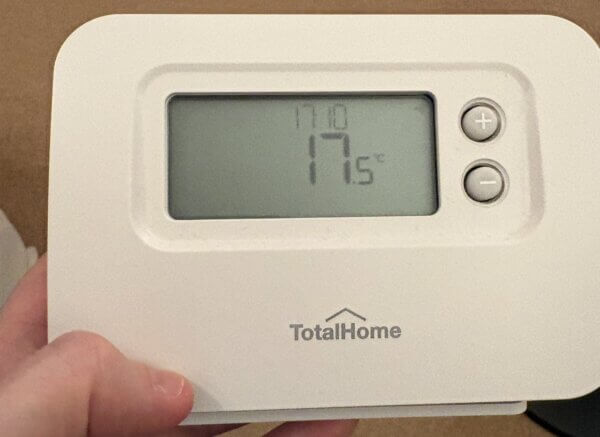 A lot of heating systems now are combining the main thermostat and timer. And, to add to the complexity, the timer no longer switches between on and off, instead it switches between two temperatures. The high temperature is what you want your heating system to reach when you are at home. This is what you would be expecting the system to aim for if you have an older room or system thermostat.
However, the lower temperature is now a minimum that your home is allowed to cool to. Studies have found that it is cheaper to keep a heating system running at a lower target when a home is empty during the day, rather than letting it cool too far. That way when you do need the heating back on, the climb up to your expected temperature is less, and more efficiently reached.
There is always an exception, and for these modern timers, the exception is when you are away for multiple days. It then becomes cheaper to switch off your heating entirely, by setting the timer to its ‘off’ position. It will only kick in if it absolutely needs to, if the weather is freezing and it needs to protect your home from frozen or burst pipes.
Smart thermostats
The latest move in heating controls now is to combine your heating systems control into a smart device or thermostat. The timer and temperature settings can be set on the device, but also by a remote app on your phone or tablet. Smart thermostats need to be installed by a professional and there are many options out there. But they do include added extras, where they can respond to your movements and track whether you are at home or not and switch your heating on or off accordingly, saving you money. Some respond to the local weather and know how much effort to put into heating your home. You can also have multiple thermostats in one home so there is better control of where the heat is used and when.
In summary…
If you’re looking to save money on how much your heating is costing you, then you need to think about how much you are heating your home and when.
Your thermostat and radiator valves are the controls that allow you to decide how much heat your system is providing and therefore how much energy it is using and costing you. Your timer clock allows you to choose when this happens, so you are not spending money on heat when there is no-one to benefit.
Reducing temperatures and working times of your heating will save you money. However, you must also stay safe and warm, so the challenge is to find the best balance that allows you to be in control of your home and know that you are getting the best use from the money you are spending.
If you would like to know more about any of these devices or topics, get in touch with our energy team and we will gladly speak to you about it. Or, ask us to complete a home energy review with you and we can talk about what settings may suit you best or show you how your timer and thermostat work.
Contact us on 0161 205 2754 or by emailing energyadvice@caritassalford.org.uk and one of our advisors will assist.
You can read more about our energy advice service by clicking here now too.
